Articles
For hydrogen to be good for business, it must be good for the environment
M. ROTE, Senior Director– Energy Transition, Environmental Defense Fund (EDF), Washington D.C. (U.S.)
Global attention turned to Brazil this past November, where a key priority for COP30 negotiators was “accelerating zero- and low-emissions technologies in hard-to-abate sectors.”1 Clean hydrogen (H2) was central to that conversation. For hard-to-electrify sectors such as steel, cement, shipping and aviation, clean H2 has real potential to reduce harmful global emissions while unlocking promising new markets.
However, the case for H2 rests on a critical factor: its environmental integrity. Without it, the value of H2 as an investment and decarbonization strategy is severely undermined. Investors, policymakers and communities must see verifiable climate benefits from H2, not just a transfer of emissions from one part of the energy ecosystem to another. Science shows that poor H2 deployment could actually increase greenhouse gases (GHGs) in some cases.2 As the world’s first international H2 standard is being finalized, the environment simply cannot be overlooked.
Market integrity depends on environmental integrity. H2 has been through its hype cycle. In the last 5 yrs, projects, policy targets and investment announcements have multiplied, then recalibrated. H2’s next phase will be one of refinement and maturation: getting the most viable projects off the ground, integrating H2 into hard-to-abate systems and proving it can compete on cost and climate values. The environmental integrity test will determine access to markets, cost of capital and the willingness of policymakers to keep supporting H2 as a decarbonization tool.
Soon to be finalized by the International Organization for Standardization (ISO), the first global H2 emissions standards aim to provide much-needed clarity for markets and investors looking to produce and trade H2 around the world. It is critical that the standard follow the latest science on emissions impact, including details around electricity sourcing, methane emissions, carbon management and H2’s own warming impact. Omitting the science is a real business risk.
H2’s environmental credibility may sound like a narrow technical matter, but it reaches far beyond this market. Every H2 derivative—from ammonia and methanol to sustainable aviation fuels—depends on credible clean H2 production. Aviation and shipping are relying on these fuels to decarbonize, and the steel and iron industries are demonstrating H2 as a replacement for fossil feedstocks. Meanwhile, investors are treating H2 as a precedent case for how new energy commodities are measured, certified and traded. Even outside the fuels sector, data centers and other large energy users are beginning to adopt H2’s “three pillar” framework for emissions integrity of renewables. The standards we set now will ripple across markets.
Individual geographies have laid the groundwork—albeit spotty—for climate integrity. In Europe, the Renewable Energy Directive (RED III), and in the U.S., the Section 45V production tax credit have set robust rules on additionality, deliverability and temporal matching of renewables. The UK has required H2 producers to mitigate their fugitive and operational H2 releases. However, buyers will compare projects across these regimes, and if international standards fall behind, producers risk fragmentation and higher transaction costs.
Buyers and investors are increasingly demanding greater climate rigor. If the choice is between H2, conventional fuels and other clean energy pathways, they must know that they are investing in a solution that delivers expected outcomes. Companies that build projects under weak rules may find that they not only fall short on expected emissions reduction targets, but they also may find their products disqualified from premium and future markets—or worse, viewed as greenwashing.
Science can reduce business risk. Using the latest science as the foundation for operational best practices and standards can only strengthen the H2 industry’s credibility by demonstrating that the industry is committed to maximizing H2’s potential and achieving meaningful emissions reductions. Accountability depends on four main components:
- Accurate accounting for electricity sourcing
- Verifiable methane limits
- Effective carbon capture
- Minimizing H2 emissions.
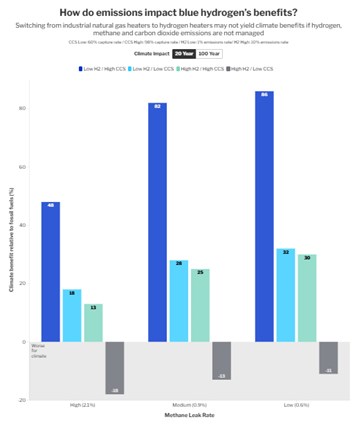
For example, if renewable-based (green) H2 does not rely on new wind or solar resources (i.e., additionality), it stands to divert resources needed elsewhere, causing the grid to backfill with fossil fuels—an effect four times as polluting as today’s fossil-based (gray) H2.3 For fossil-based H2 with carbon capture (also known as ‘blue’), methane leakage in natural gas supply chains (with total rates ranging from < 1% to 8% in certain U.S. basins)4 and underperforming carbon capture technologies (rates currently hover around 60%) could erode H2’s climate benefits by more than half in both the near and long term.5
H2 itself adds another layer of complexity. Though it does not trap heat directly, it alters atmospheric chemistry in ways that amplify warming. Pound for pound, H2 is about 37 times more potent than CO₂ over 20 yrs, and 12 times over 100 yrs.6 Even small losses matter: each 1% of H2 emitted reduces the climate benefit of a system by roughly 3% in the near term and 1.5% in the long term.5 Current estimates suggest leakage rates could range from well below 1% to > 20%, depending on infrastructure and operations.7
By neglecting these factors, the proposed ISO standard could enable H2 that is worse for the climate than the fossil fuels it is replacing (FIG. 1).
 Industry leadership is needed more than ever. At this pivotal moment for the H2 economy and the energy transition, industry leaders face a crucial choice. Supporting and encouraging operational excellence (rigorous international and national standards are just one example) will help set this emerging industry up for long-term stability, credibility and license to operate. Settling for weak rules now, even if viewed as an interim solution to facilitate a path forward, invites distrust and further uncertainty for the market.
Standards should serve as a common methodology that countries at different stages of development can apply with confidence. When gaps remain, governments and non-governmental organizations (NGOs) are left to fill them independently, which fragments the market and reduces clarity for investors and buyers.
This matters now more than ever. Countries such as Indonesia, China, Brazil and India are in the process of finalizing their H2 standards, and the approaches they adopt will shape the future of global trade.8 A consistent, science-based framework at the international level would provide governments and companies with a shared point of reference, reducing duplication, improving comparability and strengthening confidence in H2 markets worldwide.
If the ISO’s first international H2 standard recognizes this, it could set the trajectory for H2 to become a truly impactful decarbonization solution worthy of global trade. If it does not, it could undermine H2’s future. The smart bet—for both the environment and business—is clear.
LITERATURE CITED
1 COP30, “Fourth letter from the Presidency,” Brazil, June 20, 2025, online: Fourth Letter from the Presidency
2 Sun, T., E. Shrestha, S. P. Hamburg, R. Kupers and I. B. Ocko, “Climate impacts of hydrogen and methane emissions can considerably reduce the climate benefits across key hydrogen use cases and time scales,” Environmental Science & Technology, Vol. 58, Iss. 12, February 21, 2024, online: Climate Impacts of Hydrogen and Methane Emissions Can Considerably Reduce the Climate Benefits across Key Hydrogen Use Cases and Time Scales | Environmental Science & Technology
3 Esposito, D., E. Gimon and M. O’Boyle, “Smart design of 45V hydrogen production tax credit will reduce emissions and grow the industry,” Energy Innovation, April 2023, online: The Inflation Reduction Act’s
4 Environmental Defense Fund, “New data show U.S. oil & gas methane emissions over four times higher than EPA estimates, eight times greater than industry target,” July 2024, online: New data show U.S. oil and gas methane emissions over four times higher than EPA estimates, eight times greater than industry target
5 Energy Exchange, “Getting to clean: The carbon capture imperative for blue hydrogen,” Environmental Defense Fund, May 16, 2025, online: Getting to clean: The carbon capture imperative for blue hydrogen - Energy Exchange
6 Energy Exchange, “Why wait to account for hydrogen’s warming impact in standards & policies when it will cost more later?,” Environmental Defense Fund, June 24, 2025, online: Why wait to account for hydrogen’s warming impact in standards & policies when it will cost more later? - Energy Exchange
7 Esquivel-Elizondo, S., A. Hormaza Mejia, T. Sun, E. Shrestha, S. P. Hamburg and I. B. Ocko, “Wide range in estimates of hydrogen emissions from infrastructure,” Frontiers in Energy Research, Vol. 11, August 3, 2023, online: Wide range in estimates of hydrogen emissions from infrastructure
8 Green Hydrogen Organisation, “Indonesia green hydrogen contracting and legislation: Key reports launched to drive industry growth,” online: Indonesia Green Hydrogen Contracting and Legislation: Key Reports Launched to Drive Industry Growth | Green Hydrogen Organisation
Related Articles
Connect with H2Tech