Articles
Automation’s next chapter: Process control for the decentralized H2 economy
The global effort to grow the hydrogen (H2) economy is marked by rapid innovation, but development also presents a unique engineering challenge: the fundamental architecture of the industry is shifting away from the centralized model of traditional energy production. The new H2 value chain—from distributed production (e.g., electrolysis) to high-pressure fueling—is defined by decentralization, modularity and rapid deployment. This significant change demands a transformation in process control strategy.
To gain widespread adoption, H2 production costs must be lowered; presently, H2 is two to three times higher in cost per unit of energy than, for instance, gasoline. This economic imperative makes efficiency and cost reduction a primary driver for all engineering decisions. Unlike established energy sectors, the H2 industry often lacks clear standards, forcing engineers to seek optimized solutions that move beyond traditional architectures.
Legacy process control systems, which require a dedicated electrical wiring run and I/O card connection for every individual pneumatic field device, introduce cost and complexity that are unsustainable for modular systems.
To successfully expand H2 production, engineers must embrace integrated automation that delivers lower-cost, higher-performing and safer systems, a need answered by the evolution of the modern valve manifold.
Rethinking pneumatic control: The modern valve manifold. The valve manifold, also known as a valve terminal, is not a new device, but its modern form represents a crucial departure from its predecessors. In pneumatics, the manifold (FIG. 1) is a combination of multiple individual valves consolidated onto a single block with a central voltage and compressed air supply.
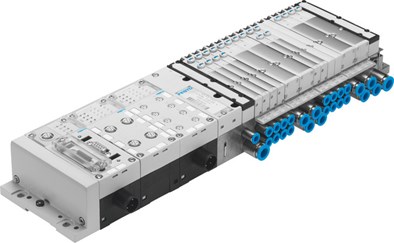
FIG. 1. A modern valve manifold with electronics on the left and pneumatic valves on the right. Manifolds are modular, flexible and configurable for the application.
The manifold replaces the traditional method of running individual wires and pneumatic hoses for every single solenoid valve from the main control panel to the field device. This consolidation provides an immediate and profound simplification for designers and installers, directly addressing the limitations of the legacy approach, providing:
- Labor savings: Manifolds mount directly to the panel wall, eliminating multiple tubing runs, individual drilling for push-in fittings in the panel wall and individual solenoid power wiring inside the panel box, significantly reducing fabrication efforts and labor hours (FIG. 2).
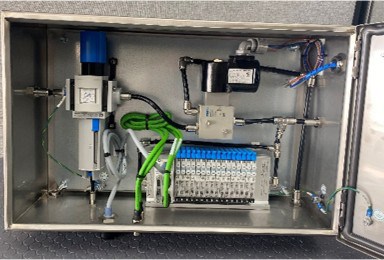
FIG. 2. This compact control panel shows how the valve manifold (center) simplifies panel construction by lowering the number of components.
- I/O consolidation: The single fieldbus connection replaces the multiple digital I/O cards required for individual solenoid valves, freeing up valuable space in the control cabinet and reducing overall hardware and software costs.
The single-wire advantage. The most significant engineering benefit is the elimination of the high wire count. Modern manifolds incorporate a central communication and power block, which connects the entire terminal via one fieldbus cable. This single wire handles both the communication (data) and power (voltage) necessary to address and control all individual valves on the terminal.
This bus communication approach also delivers:
- Enhanced diagnostics: Integrating the pneumatic controls onto a digital bus transforms the device from a simple actuator into an intelligent control node, providing better real-time diagnostics back to the programmable logic controller (PLC) or distributed control system (DCS).
Safety and environmental resilience in H2 applications. The operation of H2 equipment necessities compliance with the most stringent safety and environmental standards. There are new valve manifoldsa (FIG. 3) specifically engineered and certified to meet these non-negotiable requirements, particularly for explosive atmospheres and exposed outdoor locations.
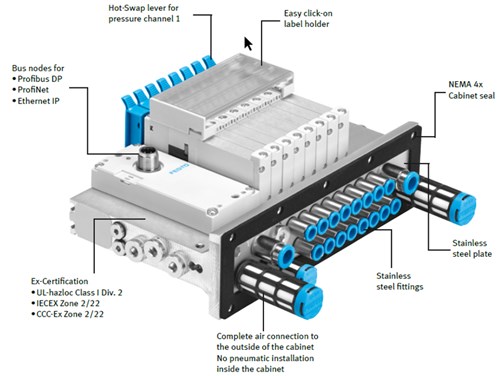
FIG. 3. The author’s company’s valve manifolda is the world’s first with fieldbus connectivity for Class 1 Div. 2 applications. This manifold also meets IECEX and CCC-Ex Zone 2/22 requirements.
Hazardous location compliance. For both large-scale production sites and decentralized fueling skids, automation components must maintain critical certifications, including:
- Explosion protection: Maintaining Class 1 Div. 2 certification (or equivalent global standards) is necessary for equipment installed in areas where flammable gases, such as H2, are present under abnormal conditions (FIG. 4).
- Environmental protection: For outdoor installations, such as electrolyzer skids or fueling station dispensing units, NEMA 4X/IP65 ratings are required to protect against the ingress of water, dust and weather. The robust, modular design of modern manifolds is essential to ensure these integrity standards are maintained across the entire assembly.
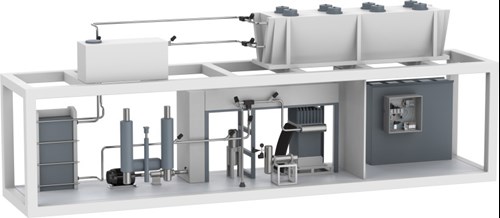
FIG. 4. The control panel (lower right) meets Class 1 Div. 2 requirements and can be located within the hazardous zone, as shown.
Integrated safety functions. Beyond basic environmental protection, modern valve terminals enable the realization of advanced functional safety. The certified devices can integrate specific components, such as vent and relief modules, to achieve required safety integrity levels (SILs), typically SIL 2/3, directly within the manifold. This eliminates the need to source and integrate separate safety components, further streamlining the system design and validation process.
By centralizing both pneumatic and electronic controls in a single, certified unit, the manifold inherently minimizes the number of individual connections exposed to the hazardous environment, reducing the overall risk profile of the equipment (FIG. 5).
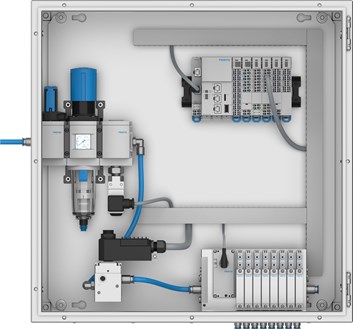
FIG. 5. A functionally safe control panel with solenoid shutdown valve (bottom left).
Integrating valve manifolds across the H2 value chain. The primary function of the valve manifold in the H2 industry is piloting process valves. In both production and dispensing applications, the manifold uses compressed air to open, close or modulate the larger ball, butterfly or diaphragm valves that control the flow of H2, water and supporting process media.
Production (electrolyzers and DCS). Even in legacy industrial setups where large-scale H2 is produced for chemical processes or where new large electrolyzers use traditional DCS-based automation, the valve manifold provides critical advantages, including:
- DCS optimization: Instead of running dual I/O cards to every controlled valve (one for setpoint and one for feedback, which is common with traditional positioners), the manifold consolidates this control. This simplifies I/O requirements and significantly reduces the complexity of the large control panel.
- Proportional control: For applications requiring precise flow and pressure regulation, not just simple ON/OFF control, modern manifolds with integrated proportional control capabilities offer a highly accurate solution (FIG. 6). This is a key differentiator from simple solenoid valves and adds value to reaction and blending processes within the H2 plant.
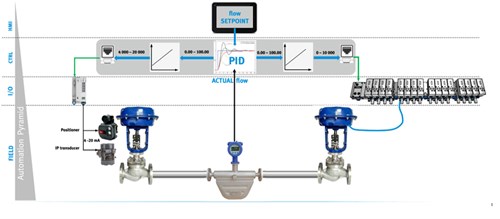
FIG. 6. On the left, wires, positioners and transducers are hallmarks of position control. On the right, the valve manifold controls the valves through a single pneumatic connection and proportional control.
Dispensing and modularization (fueling stations). The manifold’s advantages are most crucial in the modular, decentralized world of H2 fueling stations. These skids must be compact, reliable and capable of high-performance operation in challenging environments. The manifold provides the necessary standardized, robust and high-performance pneumatic control for the equipment on these dispensing skids, making the overall modular design feasible and cost effective.
The future of smart automation: Data-driven performance. The bus communication layer of the valve manifold is more than just a means of control; it is the critical link for future integration with artificial intelligence (AI) and advanced analytics. This transition transforms the pneumatic control system into a data-generating backbone ready to support the growing number of unstaffed, decentralized H2 sites.
The data generated by the manifold, such as switching times, actuation cycles and air pressure fluctuations, enables predictive maintenance. The electronic layer, often connected to emerging solutions such as the author’s company’s new softwareb, constantly analyzes this operational data to monitor valve health and detect subtle anomalies, allowing for maintenance to be scheduled before a functional failure occurs.
This remote diagnostic and predictive capability is essential for managing the H2 economy:
- Anomaly detection: Detecting slight changes in pneumatic response time, indicators of friction, leakage or component wear, allows engineers to identify a developing issue remotely, enabling timely countermeasures.
- Reduced operating expense: For the many decentralized fueling stations and small-scale production facilities that operate without dedicated onsite staff, the ability to manage and detect anomalies remotely reduces the need for expensive, time-consuming onsite interventions. The manifold effectively enables operators to manage a vast network of distributed assets from a central location.
Takeaways. Thinking out of the box for today’s needs. The H2 economy is at an inflection point. To move past the high cost and complexity of initial build-out and achieve true scale, engineers must challenge traditional automation thinking.
The modern valve manifold—with its integration of digital communication, pneumatic control and built-in safety features—is not a futuristic concept: it is a ready-to-use, non-traditional solution that directly addresses the industry’s urgent needs for efficiency, compactness and high performance. By moving beyond legacy architectures and embracing integrated components, engineers can immediately enhance the speed, cost effectiveness and reliability of their next-generation H2 projects. The technology is available today, and the time to adopt it is now.
NOTES
a The Festo VTUG valve manifold
b Festo Motion Insights Pneumatics software
ABOUT THE AUTHOR
Thomas Bertsch is Head of Process Industries in North America at Festo Corp. He has spent > 15 yrs focusing on business development within the process industries, including activities in H2, chemical processing and petrochemicals. Bertsch holds a Diplom-Ingenieur (Master’s equivalent) in industrial engineering from Albstadt-Sigmaringen University in Germany.
Related Articles
Connect with H2Tech