Articles
Unlocking hydrogen trade: Why ammonia cracking is South Korea’s gateway to clean energy
P. MISTRY, Johnson Matthey, Rugby, England
South Korea has emerged as a frontrunner in the global hydrogen (H2) transition. The government's Hydrogen Economy Roadmap is supported by a suite of demand-side incentives, including H2 power generation capacity auctions and consumption mandates. One key target is to generate 2.4% of the country's grid electricity from eligible H2 vectors by 2030.1
However, delivering on these ambitions at scale is not straightforward. South Korea’s land and clean energy resource constraints limit the feasibility of scaling low-carbon H2, an important low-carbon footprint fungible energy vector. H2 demand is expected to grow substantially across the power, industrial and transport sectors. The government’s target for clean electricity, combined with its anticipated use in industrial decarbonization (e.g., in steel and chemical production), is projected to require several million tons per year (tpy) of low-carbon H2. Additional demand is expected from the transport sector and from planned H2 refueling infrastructure. Taken together, these drivers could result in national demand reaching several tpy of H2 equivalents by the early 2030s. Domestic production alone will not be able to satisfy these needs at the appropriate price, making imports essential.
The challenge for H2 is that it is difficult to transport across borders in its elemental form. Whether as a gas or a cryogenic liquid, it presents technical and economic challenges, including low energy density, boil-off losses and costly storage. H2 carriers, such as liquid organic H2 carriers (LOHCs) and ammonia, offer varying trade-offs (TABLE 1).
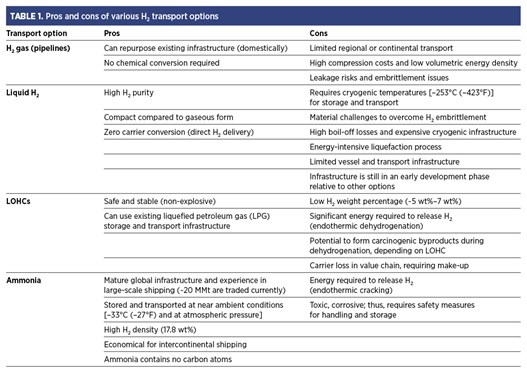
According to the International Energy Agency (IEA), H2 pipelines become economically attractive only for high-volume, inland transport, especially where existing infrastructure can be repurposed.2 For intercontinental trade, such as from the Middle East or Africa to Asia, maritime transport using ammonia is significantly more scalable and cost-efficient.
Ammonia is a strategic vector for enabling H2 trade. It allows H2 to be moved from regions with abundant renewable or natural gas and carbon sequestration resources to countries with high demand but limited production capacity. In doing so, ammonia plays a central role in the development of a global clean H2 economy. By 2050, approximately a quarter of all low-carbon ammonia produced globally is forecast to be used in H2 carrier demand, highlighting its long-term strategic importance.3
Ammonia cracking: Technology, use cases and infrastructure alignment. To unlock its constituent H2 molecules, ammonia must be cracked back into H2 and nitrogen. This is achieved using a catalytic process at temperatures typically between 600°C and 900°C (1,112°F and 1,652°F). The infrastructure can be deployed in either centralized or decentralized configurations, depending on the application.
Centralized ammonia cracking facilities are expected to be located at import terminals or within industrial clusters. These systems handle large throughputs, supplying H2 into gas grids, industrial pipelines or power generation assets.
Decentralized cracking units are smaller and located closer to the point of use. These systems are suited to distributed applications such as H2 refueling stations or offgrid industrial users. While they typically produce lower H2 volumes and require ammonia to be transported to the unit, which may present difficulties if in a densely populated area, they provide operational flexibility and help overcome infrastructure gaps in local H2 delivery.
Cracked ammonia can serve multiple end uses across South Korea’s energy system. In the power sector, it can support gas turbines and fuel cell technologies. In heavy industry, it can replace fossil fuels in high-temperature processes such as steel, cement and glass production. In the transport sector, decentralized cracking units may support H2 refueling networks. This versatility reinforces ammonia’s role as a flexible H2 vector across sectors.
Cracking ammonia domestically also contributes to clean energy security. It enables countries like South Korea, which rely heavily on energy imports, to reduce their dependence on fossil fuels. Ammonia can be stored, sourced from multiple regions and converted to H2 on demand, offering resilience and diversification.
In addition to daily supply, ammonia is increasingly being considered as a medium for seasonal H2 storage. It can be produced during periods of excess renewable generation and stored for later use during peak demand or low-output periods. This function supports grid balancing and provides a controllable, dispatchable energy source in a H2-integrated system.
South Korea’s infrastructure is already evolving in this direction. The country imported 1.35 MMt of ammonia in 2021 and plans to increase that to 4 MMtpy by 2030. In contrast, only 100,000 t of liquid H2 import capacity is expected online by 2029, according to Korea Gas Corp. Ammonia infrastructure is therefore significantly more advanced and offers greater near-term scalability. Blue ammonia import agreements, such as Lotte Fine Chemical’s partnership with SABIC and Ma’aden, further support this trajectory.
From a cost perspective, the advantage of importing green ammonia and cracking it in-market is particularly clear for South Korea. According to a project-based analysis from S&P Global, importing green ammonia and converting it to H2 locally could reduce the levelized cost of H2 compared to domestic green H2 production. For blue or carbon capture and storage-enabled H2, current cost projections suggest that importing blue ammonia and cracking it will fall within a similar cost range as producing blue H2 domestically in countries like South Korea.3 However, the limiting factor is likely to be infrastructure: the availability of carbon capture, transport and storage capacity.
Ammonia cracking also aligns with emerging policy frameworks. South Korea is developing a Clean Hydrogen Certification Scheme and a H2 authenticity program that will require traceable low-carbon origins. H2 produced from the cracking of certified blue or green ammonia is eligible for both general and clean H2 auctions, making it a viable option across multiple applications.
Furthermore, South Korea is among the first countries to implement a demand-led policy framework, focused on guaranteed H2 consumption rather than supply-side subsidies alone. This approach positions it as a test bed for technologies such as ammonia cracking. Outcomes from South Korea’s model may inform H2 import strategies in other advanced economies, particularly in Europe and Japan.
Efficiency, storage potential and the road ahead. Round-trip energy efficiency is a key consideration when assessing H2 vectors. Ammonia cracking systems typically retain between 60% and 70% of the original energy content of the H2, depending on the process design and heat integration.4 While slightly less efficient than pipeline delivery under ideal conditions, this compares favorably with LOHCs, which suffer greater energy losses.
As electrolysis capacity continues to grow globally, ammonia production from renewable sources is increasing. Power-to-ammonia projects already account for a significant share of the global electrolysis pipeline, which will increase the capacity designated for export as an energy carrier. The role of ammonia in long-duration energy storage and trade is expected to expand as H2 becomes further embedded in national energy strategies.
Efficient and cost-effective ammonia cracking will be essential as global H2 trade develops.
For South Korea, where industrial concentration, infrastructure readiness and regulatory frameworks are already aligned, ammonia cracking offers a practical and scalable solution. As the country moves from demonstration to deployment, integrating ammonia cracking into its H2 infrastructure will enable South Korea to connect global supply with domestic demand, supporting a stable, cost-effective and low-carbon energy future.
LITERATURE CITED
1 Kim, M., “South Korea’s 11th power plan makes partial progress towards decarbonization,” March 31, 2025, online: https://ieefa.org/resources/south-koreas-11th-power-plan-makes-partial-progress-towards-decarbonization
2 IEA, “Global hydrogen review 2024,” October 2, 2024, online: https://iea.blob.core.windows.net/assets/89c1e382-dc59-46ca-aa47-9f7d41531ab5/GlobalHydrogenReview2024.pdf
3 Eliseev, G., “The ammonia market today, and a bridge to the future,” Ammonia Energy Association Annual Conference 2024, November 11–13, 2024, online: https://ammoniaenergy.org/wp-content/uploads/2024/11/G-Eliseev-2024.pdf
4 IEA, “Global hydrogen review 2022,” September 22, 2024, online: https://www.iea.org/reports/global-hydrogen-review-2022
Related Articles
Connect with H2Tech