News
Important milestone for hydrogen project in Hamburg-Moorburg
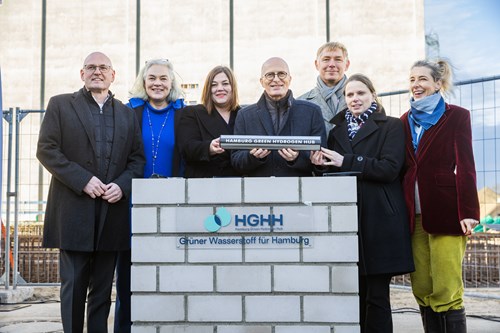
Construction of the Hamburg Green Hydrogen Hub (HGHH) has begun: Hamburg's First Mayor Dr. Peter Tschentscher laid the official foundation stone today for the construction of the 100-MW electrolyzer at the site of the former Moorburg power plant.
Together with Environment Senator, Katharina Fegebank, Economics Senator, Dr. Melanie Leonhard, and representatives of the two project partners Luxcara and Hamburger Energiewerke, he placed a time capsule in the foundation stone onsite.
The HGHH project plans to start commercial operations in the second half of 2027. Around 10,000 tpy of green hydrogen are set to be produced in Moorburg in the future. The HGHH project is thus making an important contribution to the decarbonization of the port and industry.
Dr. Peter Tschentscher, First Mayor of the Free and Hanseatic City of Hamburg: "The construction of the Green Hydrogen Hub in Moorburg is an important project for the energy transition in Hamburg. The production of green hydrogen is a future-oriented technology that can significantly reduce CO₂ emissions in industry and other sectors. Thanks to the wind energy from northern Germany, its connection to the supra-regional hydrogen network, and innovative industrial companies, Hamburg offers the best conditions for ramping up the H₂ economy. I wish Hamburger Energiewerke, Luxcara, and everyone involved in the project every success and all the best for the construction of the 100-megawatt electrolyzer!"
Dr. Melanie Leonhard, Senator of the Hamburg Ministry of Economics and Innovation: “The industrial heart of our city beats in the port – and this is precisely where we are helping to ensure that hydrogen will be produced in the future for the climate-neutral energy generation of tomorrow. The switch from fossil gas to hydrogen is an important step in making industrial processes possible even as we strive to achieve our climate goals. The electrolyzer in Moorburg is therefore part of the solution for making decarbonization a reality in Hamburg – not just as a distant plan, but in very concrete terms.”
Katharina Fegebank, Senator of the Hamburg Ministry for Environment, Climate, Energy and Agriculture: “Hydrogen is a key component on the path to climate-neutral energy supply for our industry and large companies. In Hamburg, we are creating the conditions for Hamburg to become a hydrogen gateway for Germany and Europe. Our public companies play a central role in this. The fact that the Hamburg Green Hydrogen Hub is being built on the site of the former Moorburg power plant is symbolic of Hamburg's ambitions in the heat and energy transition.”
Dr. Alexandra Bernstorff, Managing Partner Luxcara: “The Hamburg Green Hydrogen Hub is more than just an energy project. It proves that green hydrogen is an investable asset today and that a climate-friendly energy transition can be implemented quickly. When politics, industry, and institutional investors work together reliably, a former coal-fired power plant can be transformed into a competitive, climate-neutral industrial site for Hamburg and far beyond. This requires stable framework conditions and functioning markets so that projects are not just announced but actually built, as is the case with our HGHH project.”
Kirsten Fust, Spokesperson for the Management Board of Hamburger Energiewerke: “We are getting serious in Hamburg and moving into the implementation phase. We believe in hydrogen technology and are demonstrating with our Hamburg solution that pioneering green hydrogen projects can be driven forward through local commitment. However, in order to continue, we need better framework conditions at EU level, particularly with regard to the strict definition of green electricity in the Delegated Act.”
The HGHH project received funding approval from the federal and state governments last summer. Since then, the main construction contracts have been signed. The electrolyzer was ordered from Siemens Energy in September 2024.
At the same time, demolition work on the former Moorburg power plant continued. This work began in October 2023 to make room for the 100-MW electrolyzer and the connection to the hydrogen network. In the summer of this year, the HGHH project took over part of the construction site as planned and began initial preparatory construction work. The first step was to prepare the subsoil of the 16,000-m2 site for the construction of the electrolyzer building. A total of 906 vibro-compaction columns made of gravel were installed in the ground for this purpose. The floor slab has now been concreted, and the structural engineering work has begun.
The building for the electrolyzer and compressors is scheduled to be completed by the middle of next year. The stacks, the heart of the electrolyzer, will then be delivered. The electrolyzer is based on proton exchange membrane (PEM) technology. This involves splitting water into its components, hydrogen and oxygen, by using electricity along a membrane in a closed cell. This technology is particularly well suited for operation with renewable energy due to its flexible operation.
The green hydrogen will later be made available to customers via the HH-WIN hydrogen distribution network and the trailer loading station, which is also planned.
From The Archives
Connect with H2Tech