News
Kawasaki breaks ground on liquefied hydrogen terminal in Japan
Japan Suiso Energy Ltd. (JSE) and Kawasaki Heavy Industries Ltd. have held the groundbreaking ceremony for the Kawasaki LH2 Terminal, a liquefied hydrogen base in Ogishima, Kawasaki City, Japan.
The Kawasaki LH2 Terminal is the key facility for the “Liquefied Hydrogen Supply Chain Commercialization Demonstration” project subsidized by the Green Innovation Fund Project promoted by New Energy and Industrial Technology Development Organization (NEDO).
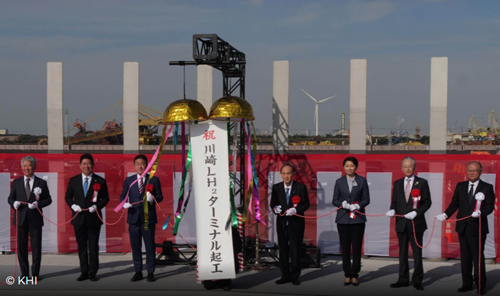
Groundbreaking ceremony in Japan. In the front row, from the left: Yasuhiko Hashimoto, Representative Director, President, and Chief Executive Officer of Kawasaki Heavy Industries Ltd.; Norihiko Fukuda, Mayor of Kawasaki City; Takuro Komori, Parliamentary Vice-Minister of Economy, Trade and Industry; Yoshihide Suga, Former Prime Minister, Member of the House of Representatives; Yuko Obuchi, Chairperson, Hydrogen Society Promotion Parliamentary League; Member of the House of Representatives; Tamotsu Saito, President, New Energy and Industrial Technology Development Organization (NEDO); and Eiichi Harada, Representative Director, President, Japan Hydrogen Energy Co. Ltd.
As the world’s first commercial-scale facility handling liquified hydrogen, this terminal will be equipped with the world’s largest 50,000-m3 liquefied hydrogen storage tank, as well as facilities for maritime cargo handling (capable of loading and unloading operations), hydrogen liquefaction, hydrogen gas supply, and lorry dispatch of liquefied hydrogen.
JSE will manage the project, while a joint venture led by Kawasaki will be the main contractor responsible for the design and construction of the facilities.
Furthermore, the liquefied hydrogen carrier (with a capacity of approximately 40,000 m3) scheduled for future construction will also be among the largest in the world. Together with the terminal, these facilities will serve as a critical foundation for the full-scale operation of the future hydrogen supply chain.

CG image of the Kawasaki LH2 Terminal
By FY2030, the project will start operating the Kawasaki LH2 Terminal and a newly constructed liquefied hydrogen carrier, while the requirements for a commercial international hydrogen supply chain (performance, safety, durability, reliability, economics, commercialization) are determined in Japan.
From 2030 onwards, the aim is to import liquefied hydrogen into Japan using liquified hydrogen carriers, and receive and store it at the Kawasaki LH2 Terminal for subsequent supply to domestic hydrogen consumers.
Facility overview:
- Location: Ogishima, Kawasaki-ku, Kawasaki City, Kanagawa Prefecture (JFE Steel Corporation site)
- Main facilities: 50,000-m3 liquefied hydrogen storage tank and facilities for maritime cargo handling (capable of loading and unloading operations), hydrogen liquefaction, hydrogen gas supply, and lorry dispatch of liquefied hydrogen
From The Archives
Connect with H2Tech