News
First successful processing of eMethanol for efuel production in Freiberg
Representatives of TU Bergakademie Freiberg and CAC ENGINEERING GmbH have visited the world's first large-scale production plant for eMethanol in Kassø, Denmark, which is the joint venture of European Energy A/S and Mitsui & Co., Ltd. The Kassø plant uses renewable energy to produce the feedstock, which was processed for the first time in the gasoline synthesis plant in Freiberg to produce renewable gasoline from biogenic CO₂ and green hydrogen.
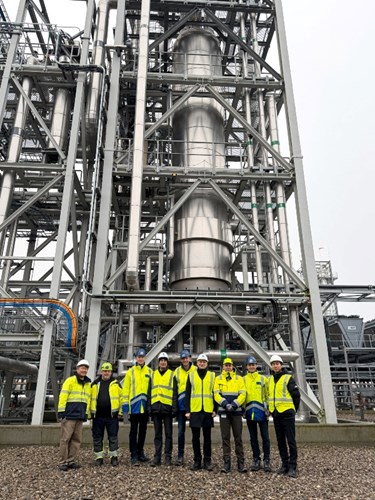
The visit to Kassø marks an important milestone in the DeCarTrans (Demonstrating a Circular Carbon Economy in Transport along the Value Chain) joint project funded by the Federal Ministry of Transport (BMV).
The end of last year saw the first production of around 23,000 liters of virtually climate-neutral gasoline from renewable electricity-based eMethanol from Denmark at the large-scale test plant in Freiberg. This development step enables the Saxons to operate the production plant more process-efficiently and at the same time reliably demonstrate that carbon recycling can achieve CO2 savings of up to 90% compared to fossil gasoline.
"The first use of eMethanol in our large-scale test plant is an important milestone towards the preparation of a first industrial plant. We were able to demonstrate the technology of the entire process chain from captured biogenic CO2 and green hydrogen to high-performance synthetic gasoline. In addition to the 90% reduction in CO2 emissions compared to conventional fuel, the increase in productivity at our plant thanks to the new Danish eMethanol is also worth highlighting," says Martin Gräbner, Professor of Energy Process Engineering at TU Bergakademie Freiberg, who is responsible for the operation of the plant.
"Our cooperation with Kassø shows that our METHAFUEL process is now based entirely on an industrially available, electricity-based carbon carrier. This is an important basis for German eFuel One, the first industrial production plant for synthetic gasoline, which we are currently planning in Lower Saxony," says Dr. Mario Kuschel, Head of R&D at CAC ENGINEERING.
eMethanol from renewable energies. The eMethanol from Kassø used in Freiberg is produced from captured biogenic CO2 and green hydrogen produced by renewable electricity.
The plant of Kassø, which was put into operation in 2025, is designed for industrial production and supplies various customers from the chemical industry and mobility sector. The application in Freiberg shows that eMethanol from large-scale plants is a versatile product that also can be used directly for downstream eFuel production.
Cooperation between science and industry in Saxony. The subproject of TU Bergakademie Freiberg, funded with €12.78 MM, is being realized in close cooperation with the technology provider CAC ENGINEERING. A part of the DeCarTrans joint research project is to demonstrate the long-term viability of the technology for synthetic gasoline production (also known as eFuel or "green" gasoline).
In the DeCarTrans test campaign from November to December 2025, the sixth of its kind, eMethanol was used for the first time. Including the renewable gasoline produced from biomethanol since 2023, a total of 253,700 liters of sustainable fuel has already been delivered to the DeCarTrans project partners.
The fuels produced are used for fuel tests, engine and vehicle tests, motorsport and selected demonstration and PR formats, among other things.
The aim of the project is to demonstrate by the end of 2026 along the entire value chain that CO₂ savings of up to 90% are possible through closed carbon cycle management. The focus is on operation under real conditions. The use of eMethanol extends the previous project approach and increases the validity of the demonstration, as a completely electricity-based feedstock is now being used.
Continuous operation of production. The second quarter pf 2026 is to see the launch a further test campaign with eMethanol, which will then provide the project partners with even larger quantities of gasoline for fuel tests and extensive vehicle tests.
The demonstration plant for synthetic gasoline was built by CAC ENGINEERING at TU Bergakademie Freiberg in 2009 as the first and largest of its kind in Europe. The current DeCarTrans joint project makes it possible to operate the gasoline synthesis in continuous use and to provide fuels in sufficient quantities for demonstration purposes. The aim is also to prove that synthetic fuels can make a significant contribution to achieving climate targets.
This demonstration will show representatives from politics, NGOs and the public that "green" fuels can significantly reduce climate-damaging emissions and represent a useful addition and essential alternative to e-mobility in a mobility approach that is open to all technologies.
From The Archives
Connect with H2Tech