News
Bridge Data Centres and Concord New Energy to develop Singapore’s barge-based hydrogen power generation solution
Bridge Data Centres (BDC) and Concord New Energy (CNE) have signed a Memorandum of Understanding (MoU) to jointly develop Singapore’s first barge-based hydrogen power generation solution tailored for next-generation AI digital infrastructure, marking a significant milestone in advancing low-carbon energy pathways for the data center sector.
The partnership represents a strategic step in BDC’s long-term roadmap to diversify power sourcing pathways, enhance energy security, and future-proof its Singapore data center portfolio amid evolving grid constraints and decarbonization dynamics.
The collaboration brings together BDC’s extensive expertise in developing and operating hyperscale data centers across Asia Pacific and CNE’s technical leadership in renewable and hydrogen energy systems. The parties will also collaborate with Nanyang Technological University (NTU), one of the world’s top universities, to support the development of Singapore’s hydrogen ecosystem Together, the parties will accelerate the research, engineering, and deployment of scalable clean energy solutions across the value chain.
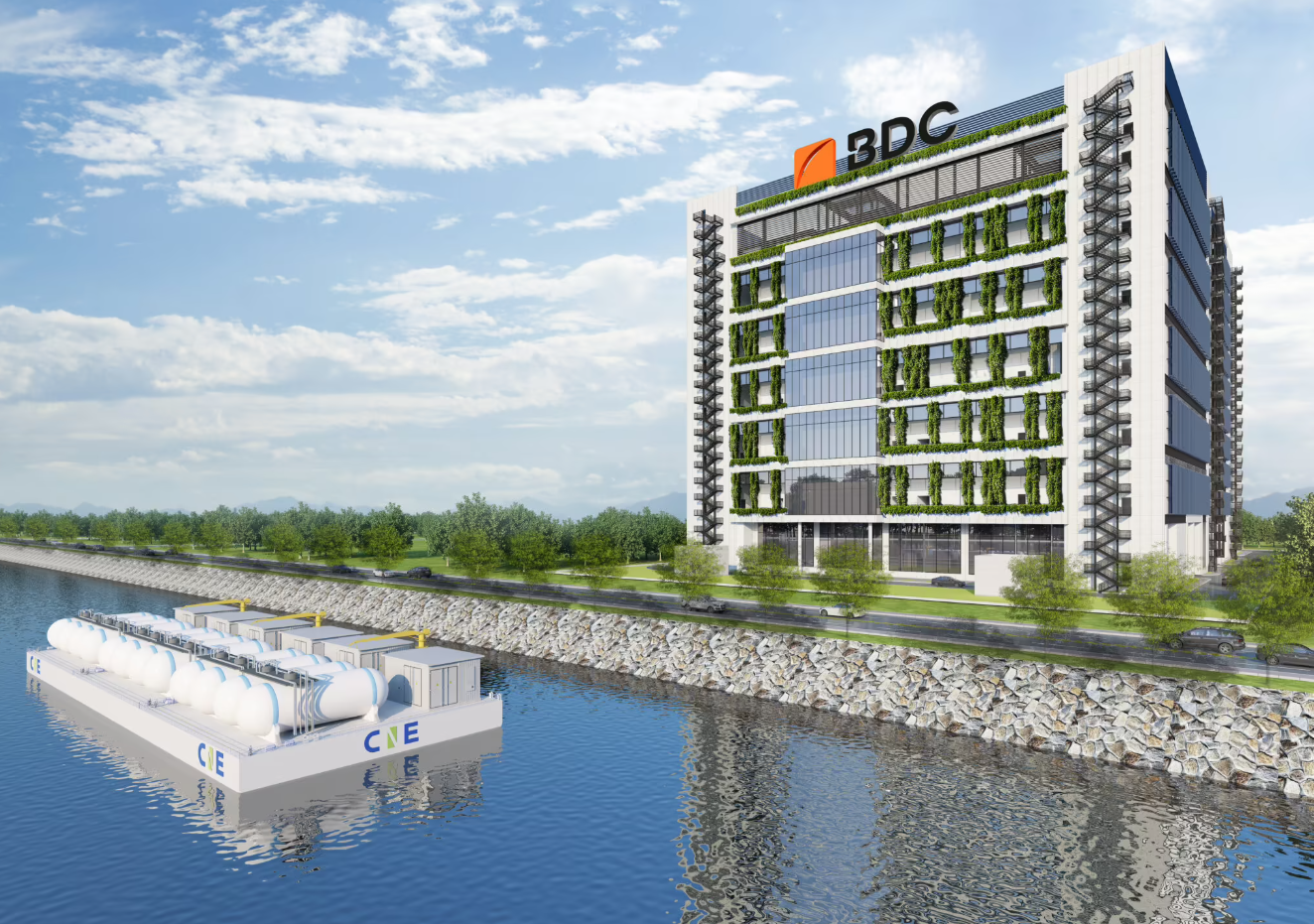
Under the MoU, the parties will explore advanced power system architectures and generation configurations designed to enhance the resilience and reliability of AI-ready data center campuses.
A key focus of the collaboration is the development of Singapore’s first barge-based hydrogen power generation model — an innovative marine-integrated deployment approach designed to deliver flexible and modular clean power capacity.
Compared to conventional land-based generation assets, a barge-based configuration offers structural advantages particularly suited to Singapore’s operating environment, including optimization of scarce land resources through offshore or nearshore deployment, enhanced safety risk segregation between hydrogen handling infrastructure and core data center operations, and greater flexibility in hydrogen transport and storage leveraging Singapore’s maritime ecosystem.
In parallel, the parties will develop scalable hydrogen supply chain frameworks covering storage, transport, and system integration to support high-density, AI-driven digital infrastructure. The alliance will also assess customized long-term power procurement structures, including renewable power purchase agreements (PPAs) and integrated energy storage solutions, to enhance operational flexibility and overall energy system resilience.
Eric Fan, Chief Executive Officer of Bridge Data Centres, said, “The accelerating demand for AI-ready data centers requires new energy architectures that are resilient, scalable, and sustainable. This collaboration with Concord New Energy reflects our commitment to diversifying long-term power pathways. By pioneering Singapore’s first barge-based hydrogen generation solution, we are exploring innovative models that integrate clean energy with advanced digital infrastructure.”
Joe Zhou, Group Vice President and Chief Executive Officer, Global Business of Concord New Energy, said, “Singapore’s hydrogen ambitions and its position as a global maritime and energy hub create a strong foundation for piloting advanced hydrogen power solutions. Through this partnership, we aim to contribute engineering expertise and scalable system design to support the decarbonization of AI-intensive data center environments.”
Advancing Singapore’s clean energy and digital infrastructure ambitions. The collaboration is expected to anchor advanced hydrogen system engineering and barge-based deployment capabilities within Singapore’s energy ecosystem. Through its Concord Clean Energy Research Centre, CNE will expand applied clean energy research and collaborate with local institutions, including NTU and public agencies, to drive the development of scalable clean hydrogen energy solutions in Singapore.
The partnership will facilitate structured knowledge transfer and local talent development in hydrogen systems integration, renewable optimization, and advanced energy engineering. The initiative is expected to support the creation of high-value jobs and specialized technical competencies in these domains.
In addition, the collaboration is anticipated to catalyze investment in hydrogen-related infrastructure, including storage, transport, generation assets, and associated supply chains, strengthening Singapore’s clean energy transition.
As Singapore scales AI-driven workloads and high-performance computing capacity, energy reliability, flexibility, and sustainability are becoming decisive enablers of digital growth. The collaboration between BDC and CNE reflects BDC’s proactive strategy to future-proof its power architecture, diversify long-term sourcing pathways, and strengthen infrastructure resilience.
By anchoring advanced hydrogen engineering and marine-integrated deployment capabilities in Singapore — a global maritime and energy trading hub — the initiative not only strengthens Singapore’s ability to pilot innovative hydrogen solutions within a land-constrained urban environment but also establishes a scalable offshore-integrated clean power framework that can be extended to Southeast Asia’s rapidly expanding AI-driven data center markets.
From The Archives
Connect with H2Tech