News
Sasol partners with DSTI, SANEDI and North-West University to build local hydrogen technology capability
Sasol, the Department of Science, Technology and Innovation (DSTI), the South African National Energy Development Institute (SANEDI) and North-West University have commissioned a 2-kW proton exchange membrane (PEM) electrolyzer at Sasol’s Research and Technology campus in Sasolburg, marking a meaningful step forward in South Africa’s drive to build local hydrogen technology capability.
Developed through the DSTI’s Hydrogen South Africa Programme, the electrolyzer will create a platform for testing, learning and skills development in hydrogen production and system integration. The program will not only test the performance of the electrolyzer but also its delivery under variable renewable electricity conditions.
The commissioning was marked at an event attended by the Minister of Science, Technology and Innovation, Professor Blade Nzimande, together with representatives from Sasol, SANEDI and North-West University.
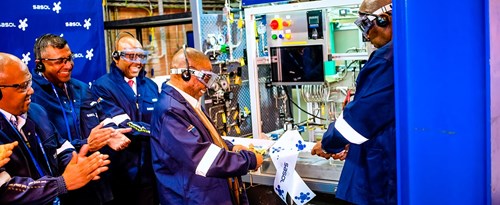
Minister Nzimande said, “The relationship between critical minerals, beneficiation, and green hydrogen in the context of DSTI’s Renewable Energy agenda is key. Central to the deployment of this 2-kW PEM electrolyzer system is the beneficiation of critical minerals, particularly Platinum Group Metals or PGMs. These minerals are key to fueling industries of the future and our aim is to ensure South Africa becomes a major player in key upstream, mid-stream and downstream parts of these future industries.
“We are confident that the knowledge and insights generated through this system will help us move closer to more efficient, commercially competitive, scaled production of green hydrogen, expand our export portfolio, and stimulate domestic utilization of green hydrogen in support of a net-zero economic future.”
Sarushen Pillay, Sasol Executive Vice President: Business Building, Strategy and Technology, said “This commissioning is a powerful example of what can be achieved when government, academia and industry work together to advance South Africa’s future energy security. As Sasol, we are excited to partner with the DSTI, SANEDI and North-West University in turning South Africa’s green hydrogen ambitions into practical capability. Hydrogen is an important building block for producing sustainable fuels and chemicals, and this program provides a unique industrial platform to advance locally developed electrolyzer technology. The fact that this electrolyzer was built by HySA here in South Africa and will be tested at Sasol’s industry-leading R&T campus in Sasolburg is a significant milestone for South Africa’s hydrogen landscape,” said Pillay.
Professor Dmitri Bessarabov directs the Hydrogen South Africa (HySA) Infrastructure Centre of Competence at North West University added, “The successful localization and industrial translation of technologies and intellectual property (IP) developed by HySA at North-West University (NWU), supported by rigorous demonstration, testing, validation, and progressive maturation towards higher Technology Readiness Levels (TRLs), through strategic partnerships with industrial champions such as Sasol, remain fundamental pillars underpinning the success and impact of the HySA Flagship Programme funded by the Department of Science, Technology and Innovation.”
The SANEDI Board Chair, Sicelo Xulu handed over the hand over report and the certificate of completion to the Minister, Prof Blade Nzimande. The handover report contains the details of the electrolyzer and the details of all the standards that the electrolyzer had to conform to. He also handed over the certificate of completion for the project to signify the successful completion of the task that SANEDI was given by the DSTI.
Xulu said, “This is a great milestone for South Africa’s publicly-funded research that SANEDI has been driving on behalf of the DSTI. The data that will be collected using this electrolyzer will go a long way in advancing South Africa’s hydrogen economy using local knowledge and local resources including the abundant platinum Group metals, the solar radiation, the wind, the land and ocean water that can be desalinated and used to produce both green hydrogen and salt.” Xulu further indicated that this project is well aligned to the SANEDI Mandate of directing, monitoring and implementing national research in energy.
Through this work, Sasol and its partners are helping to build the knowledge, skills and technology platforms needed to grow South Africa’s hydrogen economy. While still at an early stage, the commissioning represents a hopeful step towards a future where locally developed innovation can support industrial growth, lower-carbon energy solutions and new opportunities for the country.
From The Archives
Connect with H2Tech